You flip the switch on your range hood expecting that familiar hum and whoosh of air, but instead you get silence. Or maybe you hear the motor running, but the fan blades aren’t moving at all. Either way, you’re stuck cooking with no ventilation, and your kitchen is about to smell like last night’s salmon for the next three days.
The good news is that most range hood fan problems are fixable without calling in a pro. Let’s walk through the most common culprits and how to get your ventilation system back in action.
The Motor Runs But Nothing Spins
This is one of the more common scenarios. You can hear the motor humming away, but the fan blades stay perfectly still. The issue here usually comes down to a mechanical disconnect between the motor and the fan itself.
First, turn off the power to your range hood at the breaker box. Safety first. Then remove the filters and any covers to access the fan assembly. Check if the fan blade is loose on its shaft. Over time, the set screw that holds the blade in place can work itself loose from vibration.
Tighten that set screw with an Allen wrench, and you might be done in five minutes. While you’re in there, try spinning the fan blade by hand. It should rotate smoothly without wobbling or rubbing against anything.

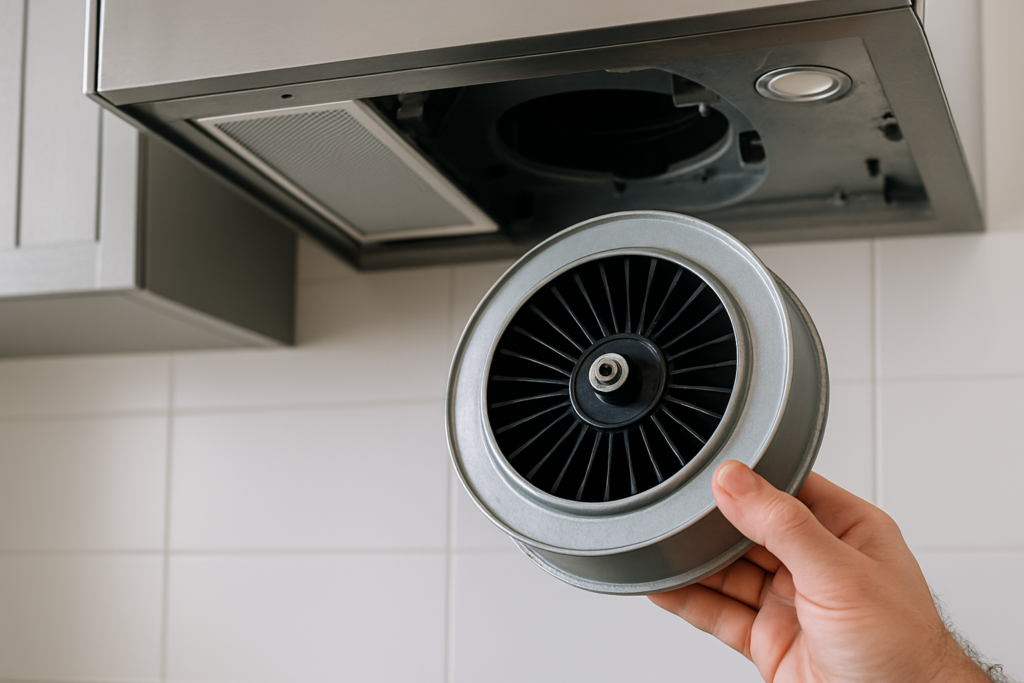
Range Hood Blower Wheel
A replacement blower wheel can solve issues with damaged or worn fan assemblies
Sometimes the motor shaft itself is worn down, creating slippage even when the set screw is tight. You’ll notice flat spots or grooves on the shaft where it should be round. In that case, you’re looking at either replacing the motor or machining a new mounting point on the fan blade hub.
Understanding Range Hood Motor Failures
Unlike washing machines or dryers, range hoods don’t use belts. The fan mounts directly to the motor shaft, which makes the design simpler but also means motor failure is more likely to stop everything cold.
Range hood motors typically last 10-15 years depending on use. They’re exposed to grease, heat, and moisture constantly, which takes a toll on the bearings and windings. When a motor starts to fail, you’ll usually get warning signs before it dies completely.
Listen for grinding noises, excessive vibration, or a burning smell when the hood is running. These indicate worn bearings or overheating. You might also notice the fan speed decreasing over time, even on the highest setting.
Testing the motor requires a multimeter. With power off, disconnect the motor wires and test for continuity. A functional motor should show resistance (usually between 3-30 ohms depending on the model), while a burned-out motor shows infinite resistance or a short to ground.

Range Hood Motor Replacement
Universal motors fit many hood models and bring your ventilation back to life
Replacing a range hood motor isn’t terribly difficult for most models. You’ll need to remove the old motor from its mounting bracket, disconnect the wiring, and reverse the process with the new motor. Just make absolutely certain you get a motor with matching specs for voltage, RPM, and mounting dimensions.
The Mysterious Lid Switch Problem
Here’s where things get interesting. Some higher-end range hoods, particularly island and downdraft models, include safety switches that prevent operation when certain conditions aren’t met. These work similarly to the lid switch on a washing machine.
These switches might be tied to the grease filter installation. Remove your filters and look for a small button or lever switch in the filter channel. This switch tells the hood that filters are properly installed. Without filters in place, the switch stays open and cuts power to the motor.
Why would manufacturers do this? Running a range hood without filters can pull grease directly into the motor housing and ductwork, creating a serious fire hazard. The safety switch prevents operation until you’ve got proper filtration in place.
Test the switch by pressing it manually while the hood is turned on. You should hear a click, and the motor should activate. Switches can get caked with grease and fail to actuate properly even when filters are installed. Clean around the switch with degreaser and a small brush.
Another type of safety switch monitors duct backdraft dampers on some models. These prevent outside air from flowing back through the hood when it’s off. A stuck damper can trigger a switch that disables the motor. Check your ductwork for a spring-loaded flap near the hood outlet and make sure it moves freely.
Grease and Gunk: The Silent Killer
You’d be surprised how often the fix is simply cleaning. Grease buildup can seize fan bearings, gum up motors, and add enough weight to fan blades that they won’t spin.
Pull out your filters and really inspect them. Hold them up to a light. Can you see through them? If not, they’re probably restricting airflow to the point where your motor struggles. Range hood filters need cleaning every month or two depending on how much you cook.
Soak metal mesh filters in hot water with dish soap and baking soda for 15-20 minutes. For really stubborn grease, use a commercial degreaser. Charcoal filters in recirculating hoods aren’t washable and need replacement every 3-6 months.
While the filters are out, clean the fan blades and housing. Use a degreaser and old toothbrush to get into the crevices. Grease buildup on the blades creates imbalance, which causes vibration and premature bearing wear. A clean fan spins more efficiently and puts less strain on the motor.
When to Replace vs. Repair
Sometimes fixing an old range hood just doesn’t make sense. Motors for older or discontinued models can be hard to find and expensive when you do locate them. Labor costs add up quickly if you’re hiring someone.
As a general rule, if repair costs exceed 50% of replacement cost, buy new. A basic range hood starts around the cost of a nice dinner out, while a quality model with good CFM ratings and quiet operation won’t break the bank.
Consider upgrading if your current hood is underpowered for your cooking style. You need about 100 CFM (cubic feet per minute) for every 10,000 BTUs of cooktop output. For electric ranges, aim for at least 200-300 CFM. Serious cooks with gas ranges need 400 CFM or higher.

Range Hood Installation Kit
Everything you need for a clean installation including duct connectors and mounting hardware
Also factor in noise levels. Older hoods can hit 65-70 decibels on high, which is like having a vacuum cleaner running constantly. Modern hoods with improved fan designs operate at 40-50 decibels while moving more air.
Frequently Asked Questions
Can I run my range hood without the fan working?
Technically yes, but you really shouldn’t. The light will still work, but you’re losing all the ventilation benefits. Cooking generates moisture, grease particles, and combustion byproducts (especially with gas ranges) that need to be exhausted. Running your range without ventilation leads to grease buildup on cabinets, walls, and ceilings, plus potential air quality issues. Fix the fan or use portable ventilation fans temporarily.
Why does my range hood fan work on some speeds but not others?
This points to a control board or capacitor issue rather than the fan motor itself. Most range hoods use a multi-tap motor or capacitor-based speed control. When one speed setting fails, it’s usually a failed capacitor or bad relay on the control board. You can test capacitors with a multimeter set to capacitance mode. Control boards are typically replaced as a complete unit rather than repaired.
How long should a range hood motor last?
With regular cleaning and moderate use (1-2 hours daily), expect 10-15 years from a quality range hood motor. Heavy use, lack of maintenance, or cheap construction can cut that to 5-7 years. The bearing assembly usually fails first. Keep your filters clean and the motor will last longer, since it won’t have to work as hard to pull air through. Running the fan for a few minutes after cooking helps cool the motor and extend its life.
This article contains affiliate links. We may earn a small commission at no extra cost to you.