You walk into your kitchen expecting to pull out a perfectly baked casserole, but instead you’re greeted with lukewarm disappointment. When your oven refuses to heat properly, it throws off your entire cooking routine and can leave you scrambling for dinner solutions. While modern ovens are fairly reliable appliances, they can develop heating issues for several reasons, from simple fixes to problems that need professional attention.
Before you panic and start shopping for a new oven, most heating problems have identifiable causes and solutions. Understanding what’s going wrong can save you time, money, and the frustration of trial-and-error troubleshooting. Let’s look at the most common culprits behind an oven that won’t reach the right temperature.
Check Your Heating Elements First
The heating elements are usually the first place to look when your oven isn’t getting hot enough. Electric ovens rely on two elements: a bake element at the bottom and a broil element at the top. When one of these fails, your oven will struggle to maintain proper temperatures.
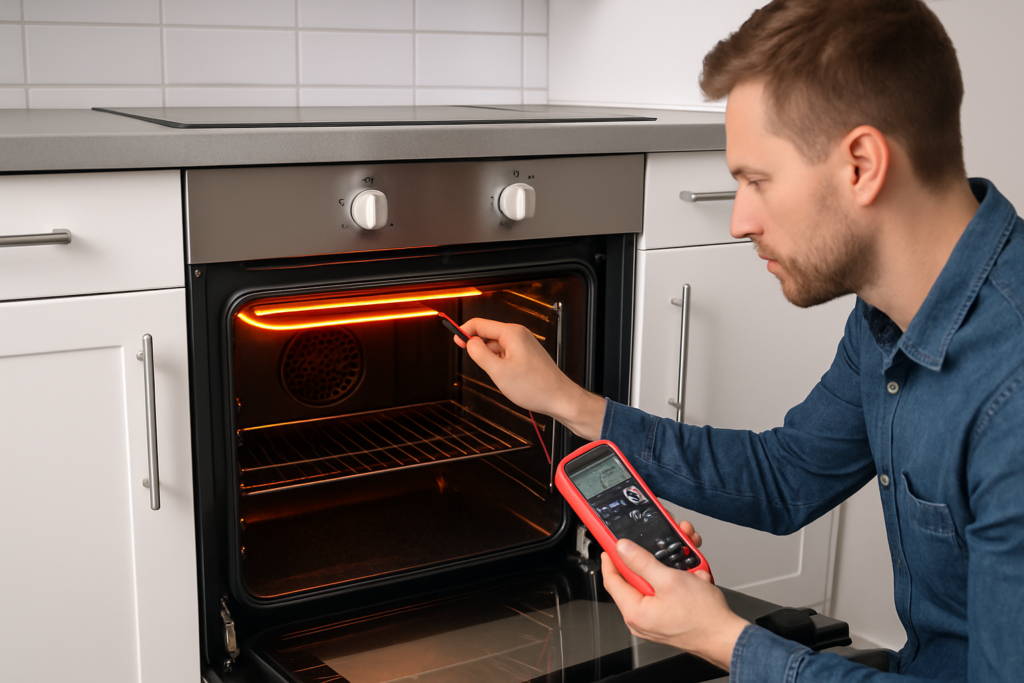
You can visually inspect these elements by turning on your oven. A working element should glow bright red when heating. If you see dark spots, cracks, or blisters on the element, or if it doesn’t glow evenly, it needs replacement. Sometimes an element fails gradually, working at reduced capacity before it stops completely.
Replacing a heating element is usually a manageable DIY project. Most elements are held in place with two screws at the back of the oven cavity and connect with simple plug-in terminals. Just make sure you unplug the oven first and write down which wire goes where.

Universal Oven Heating Element
Compatible with most standard electric ovens and easy to install yourself
Temperature Sensor Issues Can Fool Your Oven
Your oven’s temperature sensor acts like its brain, telling it when to heat up and when to shut off. This sensor, which looks like a thin metal probe sticking into the oven cavity, measures the internal temperature and communicates with the control board. When it malfunctions, your oven might heat too much, too little, or cycle on and off erratically.
A faulty sensor won’t necessarily stop working completely. It might give inaccurate readings that throw off your oven’s performance. You might notice your cookies burning on the edges while staying raw in the middle, or roasts taking much longer than they should.
You can test the sensor with a multimeter if you’re comfortable with basic electrical work. At room temperature (around 70°F), the sensor should read between 1,000 and 1,100 ohms. As the oven heats, this resistance should increase steadily. If the readings are way off or don’t change, the sensor needs replacing.
Gas Oven Problems: Igniters and Safety Valves
Gas ovens have different components that can cause heating problems. The igniter is the most common failure point in gas ovens. This small device glows to ignite the gas, and over time it can weaken. You’ll see it glow, but if it’s not hot enough, it won’t open the safety valve to release gas.
A weak igniter will glow for 90 seconds or more without lighting the gas. A healthy igniter should ignite the gas within 30 to 45 seconds. This is one of those situations where replacing the part often costs less than a service call, and the job is relatively simple for someone comfortable working with gas appliances.
The gas safety valve can also fail, though this is less common. If gas isn’t flowing even though the igniter glows properly, the valve might be stuck closed. This usually requires a technician since working with gas systems needs extra caution.

Gas Oven Igniter
Fixes the most common gas oven heating issue and typically installs in under 30 minutes
Control Board and Calibration Problems
Sometimes the issue isn’t with the heating components themselves but with the oven’s control system. The electronic control board manages all the oven’s functions, and when it glitches, you might experience inconsistent heating or temperature swings.
Before assuming the control board has failed, check if your oven just needs calibration. Many ovens allow you to adjust the temperature calibration through the control panel. Your owner’s manual will have instructions, but typically you hold down certain buttons to enter calibration mode and adjust up or down by 35 degrees or so.
To check if calibration is the issue, use a separate oven thermometer to verify the actual temperature. Place it in the center of the oven, set your oven to 350°F, and wait 20 minutes. If the thermometer consistently reads 25 degrees higher or lower, calibration will fix your problem.
Control board replacement is expensive and usually requires a professional. Boards can fail due to power surges, moisture damage, or simply age. If calibration doesn’t help and you’ve ruled out other components, the control board might be the culprit.
Door Seal and Insulation Concerns
An often-overlooked cause of poor oven heating is a damaged door seal. That rubber gasket around the door keeps heat inside where it belongs. When it cracks, tears, or becomes compressed, heat escapes and your oven has to work harder to maintain temperature.
Check your door seal by closing the oven door on a dollar bill. If you can pull the bill out easily, the seal isn’t tight enough. You should also look for visible damage like cracks or gaps in the gasket material. Replacing a door seal is inexpensive and takes about 15 minutes.
Damaged insulation inside the oven walls can also cause heating problems, though this is less common. If you’ve noticed your oven’s exterior getting unusually hot or if you can see damaged insulation through the vents, this might be your issue. Insulation repair usually needs professional help since it involves disassembling the oven cabinet.
When to Call a Professional
Some oven problems are perfect for DIY repairs, but others really need expert attention. Call a technician if you’re dealing with gas line issues, complex electrical problems, or if you’ve replaced obvious parts without solving the problem.
Also consider the age of your oven. If it’s over 15 years old and having major heating problems, the repair cost might approach the price of a new unit. Modern ovens are more energy-efficient, so replacement could actually save you money long-term on utility bills.
Keep safety in mind too. Always disconnect power before working on electric ovens, and turn off the gas supply before touching gas oven components. If you’re not comfortable with electrical or gas work, there’s no shame in hiring someone who does this every day.
Frequently Asked Questions
How long should an oven heating element last?
Most oven heating elements last between 5 and 10 years with regular use. Heavy users who bake daily might see failures on the earlier end, while occasional users can get more life from their elements. High-heat cooking like broiling at maximum temperature also wears out elements faster than moderate-temperature baking.
Why does my oven take forever to preheat?
Slow preheating usually indicates a weakening heating element or igniter that’s still working but not at full strength. A functioning electric oven should preheat to 350°F in 15 to 20 minutes. Gas ovens are typically a bit faster. If yours takes 30 minutes or more, start by checking the heating element or igniter condition, as these degrade gradually before failing completely.
Can I use my oven if only one element works?
You can use an oven with only the bottom element working for baking, though heat distribution won’t be ideal. You’ll need to rotate dishes more frequently and possibly adjust cooking times. However, you won’t be able to broil without the top element. This workaround is fine temporarily, but plan to replace the failed element soon for proper cooking results and even heating.
This article contains affiliate links. We may earn a small commission at no extra cost to you.