Few things are more frustrating than flipping the switch on your garbage disposal and hearing nothing but silence. No grinding, no whirring, just dead quiet. Or maybe you hear the motor humming, but the blades aren’t doing anything. Either way, you’ve got a problem that needs fixing before your kitchen sink turns into a science experiment.
The good news is that most garbage disposal spinning issues are fixable without calling a plumber. I’m going to walk you through the most common causes and show you exactly how to get that disposal back in action.
Understanding How Your Garbage Disposal Works
Before we troubleshoot, you need to understand the basic mechanics. Your garbage disposal has a motor that spins a turntable with impellers (not blades, technically). When food waste hits that spinning plate, the impellers fling it against a grind ring that breaks everything down.
Most modern disposals don’t use belts anymore. They’re direct-drive units where the motor shaft connects straight to the grinding assembly. This is important because if someone mentions checking the belt, they’re probably thinking of old models from the 1980s or earlier.
The motor itself is pretty simple. It’s an electric motor that runs on either 120V or 240V (most residential units are 120V). When you flip the wall switch, power flows through the motor windings and creates the magnetic field that makes everything spin.
Why Your Disposal Won’t Spin
The Motor Is Jammed
This is the number one culprit, hands down. Something hard got into your disposal and locked up the impellers. Could be a bone fragment, a piece of glass, silverware, or even fruit pits. When the grinding plate can’t turn, the motor tries to work but goes nowhere.
You’ll usually hear humming when this happens. The motor is getting power and trying to spin, but it’s physically blocked. If you don’t shut it off quickly, you risk burning out the motor.
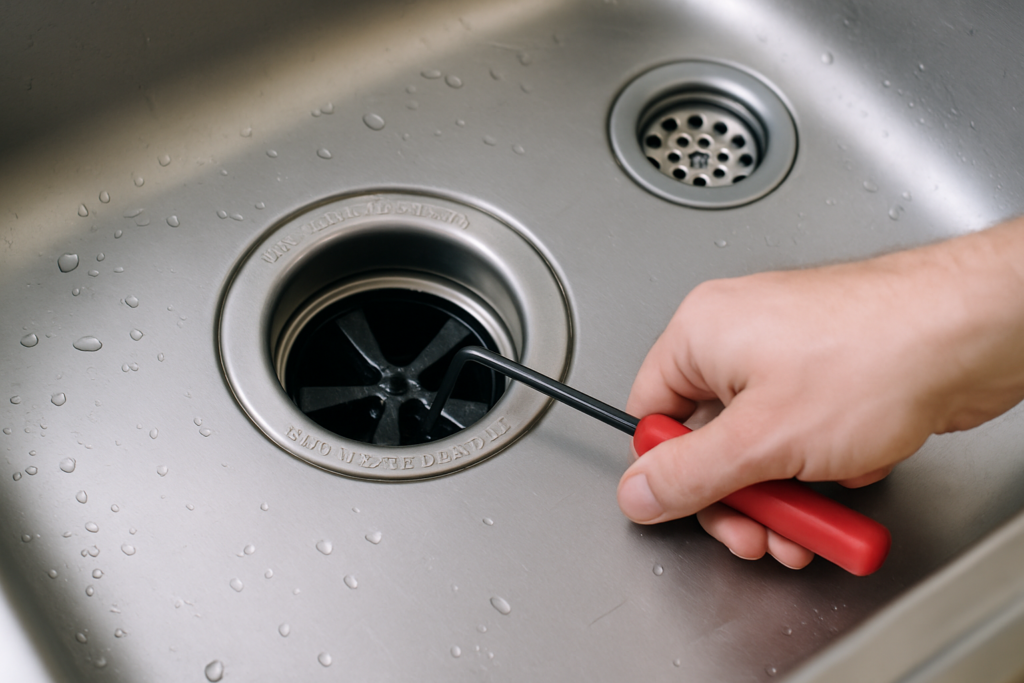
To fix this, you need to manually rotate the impeller plate. Most disposals have an Allen wrench socket on the bottom center of the unit. Grab a 1/4-inch Allen wrench (sometimes called a hex key) and insert it into that socket. Turn it back and forth several times until the plate moves freely.

Garbage Disposal Wrench Set
Essential tool for manually freeing jammed disposal impellers
Some InSinkErator models come with a special wrench, but any 1/4-inch Allen wrench works fine. Keep one under your sink for future jams.
If your disposal doesn’t have a bottom socket (some older or budget models don’t), you can use a broom handle. Stick it down into the disposal from the top and push against one of the impellers to rotate the plate manually. Just make sure the power is completely off first.
The Overload Has Tripped
Every garbage disposal has a thermal overload switch on the bottom. It’s a red button that pops out when the motor overheats or draws too much current. This is a safety feature that prevents the motor from burning up.
After you’ve freed a jam, you need to press this reset button. Let the motor cool for about 15 minutes first. The button is usually red and located on the bottom of the disposal unit. Press it firmly until you hear or feel it click back into place.
If the button won’t stay in, or if it pops right back out, your motor might have a more serious problem. But try it a few times after the unit has cooled completely.
Power Supply Issues
Sometimes the problem isn’t the disposal at all. Check your circuit breaker to make sure it hasn’t tripped. Garbage disposals typically run on their own 15-amp or 20-amp circuit.
Also check the outlet if your disposal plugs in (not all are hardwired). Try plugging in another appliance to verify the outlet works. I’ve seen people spend an hour troubleshooting a disposal when the real problem was a tripped GFCI outlet.
Dead Motor
If you’ve freed any jams, reset the overload, confirmed you have power, and the disposal still won’t run at all (no humming, no noise), the motor is probably dead. Motors fail eventually, especially in disposals that see heavy use.
A motor replacement isn’t practical. The labor costs more than a new disposal unit, and by the time a motor fails, the rest of the unit is usually pretty worn too. You’re looking at a replacement situation.
The Belt Question (For Older Units)
Here’s where I need to clarify something. Modern garbage disposals don’t have belts. They haven’t for decades. But if you’ve got a house built before 1990 with the original disposal, you might have a belt-driven unit.
These old-style disposals have the motor mounted separately with a belt connecting it to the grinding assembly. The belt can break, slip off, or wear out over time.
To check or replace a belt on these antiques, you’ll need to access the motor compartment. This usually involves removing screws or clips on the side of the unit. You’ll see the belt loop pretty clearly once you open it up.
Honestly, if you’ve got a belt-driven disposal, I’d recommend replacing the entire unit with a modern direct-drive model. They’re more efficient, quieter, and more reliable. A decent InSinkErator Evolution or Badger model will outlast any repair you make to a 30-year-old disposal.
Lid Switch Issues (On Batch Feed Models)
Most disposals are continuous feed models that run whenever you flip a wall switch. But some homes have batch feed disposals that only run when you insert and twist a special lid.
These units have a safety switch that prevents operation unless the lid is properly seated. If that switch fails or gets misaligned, your disposal won’t spin even though nothing else is wrong.
You can test the switch with a multimeter. Remove the lid, locate the switch mechanism (usually visible from the top), and check for continuity when you manually press the switch actuator. If there’s no continuity, the switch needs replacement.
Batch feed disposals are safer around kids and pets, but the lid mechanism adds another failure point. Parts can be hard to find for older models too.
DIY Repair vs. Replacement
Here’s my take after fixing hundreds of these things: if your disposal is less than five years old and just jammed, absolutely fix it. Clear the jam, hit the reset, and you’re good to go.
If your disposal is more than eight years old, consider replacement instead of extensive repairs. A quality 3/4 HP disposal costs less than you think and will give you another decade of service.
Never attempt to repair a disposal with a cracked housing or visible damage to the grinding chamber. Water and electricity don’t mix, and a leaking disposal with exposed electrical components is dangerous.
For motor replacements or complex repairs, the math doesn’t work out. A plumber will charge you for at least an hour of labor, and replacement motors cost almost as much as a new disposal. Just upgrade to a new unit.

InSinkErator Evolution Excel
Top-tier disposal with powerful 1 HP motor and excellent jam protection features
Preventing Future Spinning Problems
Most disposal jams are completely avoidable. Stop putting bones, fruit pits, and fibrous vegetables like celery down the disposal. These are the main jam culprits.
Run cold water before, during, and for 15 seconds after using the disposal. Hot water melts fats that then solidify in your pipes. Cold water keeps everything solid so it grinds and flushes properly.
Feed waste gradually. Don’t cram half a plate of food down there at once. Your disposal can handle a lot, but it needs time to grind and clear each batch.
Every month, grind up some ice cubes and citrus peels. The ice helps clean the grinding components, and citrus freshens things up. This isn’t just for smell, it actually helps prevent buildup that can contribute to jams.
Keep that Allen wrench handy under the sink. When you catch a jam early and free it immediately, you prevent motor damage and extend the disposal’s life.
Frequently Asked Questions
Can I use chemical drain cleaners in a garbage disposal?
No, absolutely not. Chemical drain cleaners can corrode the internal components of your disposal and damage the seals. They’re also ineffective on mechanical jams. Use the Allen wrench method to clear jams and run cold water with dish soap for cleaning. For tough odors, try the ice and citrus method I mentioned earlier.
Why does my disposal hum but not spin even after I’ve cleared the jam?
The motor might have burned out from running while jammed. Even a few seconds of running against a jam can overheat the motor windings. Make sure you’ve pressed the reset button on the bottom after the unit has cooled for at least 15 minutes. If it still just hums after resetting, the motor is likely damaged and you’ll need a replacement disposal.
How long should a garbage disposal last?
A quality disposal should last 10-15 years with proper use and maintenance. Budget models might only give you 5-8 years. Factors that affect lifespan include how often you use it, what you put down it, and water quality (hard water can accelerate wear). InSinkErator’s higher-end models like the Evolution series tend to outlast cheaper alternatives.
Is it normal for my disposal to spin slowly?
No, that’s not normal. Disposals run at a fixed RPM (usually around 1725 or 2800 depending on the model). If yours seems sluggish, you probably have a partial jam or buildup restricting movement. Turn it off, clear any obstructions, and clean the grinding chamber thoroughly. Slow spinning can also indicate motor problems or worn bearings, which usually means replacement time.
This article contains affiliate links. We may earn a small commission at no extra cost to you.