There’s nothing quite as frustrating as preheating your oven for dinner only to realize it’s completely unresponsive. No lights, no heat, no familiar hum of the heating elements warming up. Before you panic and call an expensive repair service, you should know that many oven power issues have simple fixes you can tackle yourself.
Most oven failures fall into a handful of common categories, and many don’t require replacing the entire appliance. Let’s walk through the most likely culprits and how to get your oven working again.
Check Your Power Supply First
This might sound obvious, but power supply issues cause more oven failures than you’d think. Electric ovens draw significant power, typically 30 to 50 amps, which means they’re more susceptible to power disruptions than smaller appliances.
Start by checking if your oven is properly plugged in. Pull the oven away from the wall and inspect the power cord connection. Look for any signs of damage, burning, or loose connections. Sometimes during cleaning or moving nearby items, the plug can work itself partially loose from the outlet.
Next, check your home’s circuit breaker panel. Find the breaker dedicated to your oven (it’s usually a double-width breaker). Even if it doesn’t look tripped, flip it completely off and then back on. Breakers can trip partially without showing obvious visual signs.
For gas ovens with electronic ignition, you’ll still need electricity for the control panel and igniter. Check that the power cord is connected and test the outlet with another device to confirm it’s receiving power.
Try a Hard Reset
Modern ovens are basically computers with heating elements. Like any computer, they can glitch and need a reboot. A hard reset solves a surprising number of control panel and display issues.
To perform a hard reset, locate your oven’s dedicated circuit breaker and switch it off. Wait at least five minutes (some technicians recommend 10-15 minutes for a complete capacitor discharge). Then flip the breaker back on.
You can also unplug the oven directly if you can access the outlet, but most built-in ovens make this difficult. The breaker method works just as well.
After the reset, check if the control panel lights up and responds to inputs. This simple fix resolves issues caused by power surges, temporary glitches, or stuck control board processors.
Inspect Your Thermal Fuse
The thermal fuse is a safety device designed to cut power to your oven if it overheats. When this fuse blows, your oven won’t turn on at all. Unlike circuit breakers, thermal fuses don’t reset. Once blown, you need to replace them.
The thermal fuse location varies by model, but it’s typically found behind the control panel or at the back of the oven cavity. You’ll need to remove the back panel or control panel to access it. Check your oven’s service manual for the exact location.
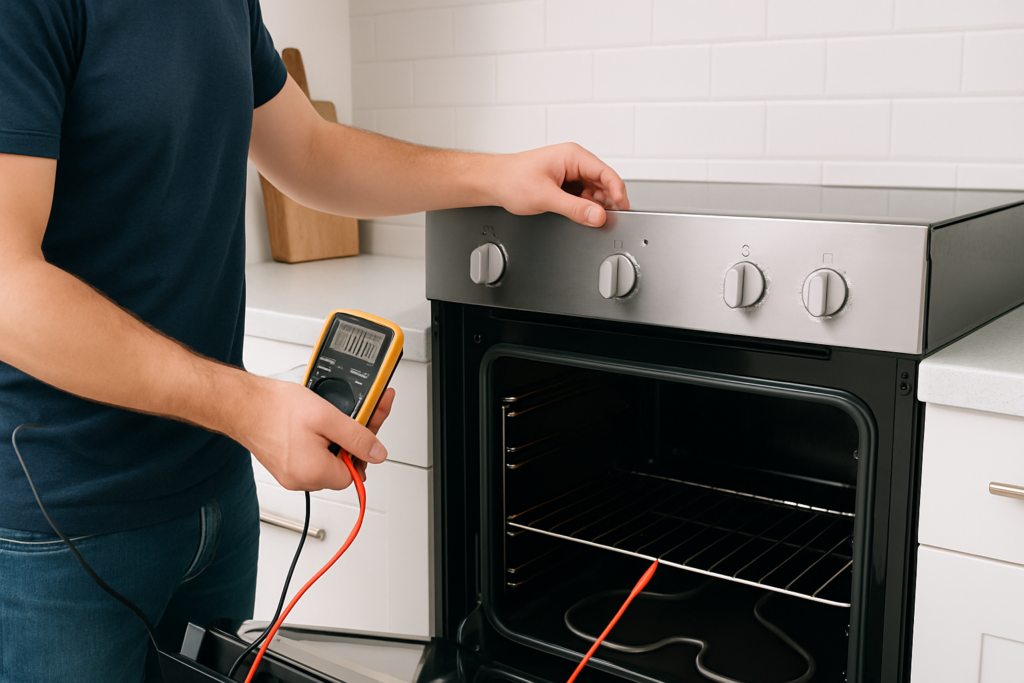
To test if your thermal fuse has blown, you’ll need a multimeter. Set it to the ohms setting and touch the probes to each end of the fuse. A working fuse shows continuity (a reading close to zero). No continuity means the fuse is blown and needs replacement.

Oven Thermal Fuse
Essential replacement part that’s affordable and prevents complete oven failure when it blows
Thermal fuses blow for a reason, usually because of actual overheating or a faulty component causing temperature spikes. After replacing the fuse, monitor your oven closely. If it blows again quickly, you have a deeper issue that needs professional diagnosis.
Common Component Failures
If power supply and fuses check out, you’re likely dealing with a failed component. Here are the most common culprits.
Heating Elements
Electric ovens have two heating elements: the bake element at the bottom and the broil element at the top. When these fail, you might get partial oven function or none at all, depending on your model’s design.
Visually inspect both elements for cracks, blisters, or holes. Turn on the oven and watch to see if the elements glow red. A broken element won’t heat up at all. You can test elements with a multimeter for continuity, just like the thermal fuse.

Oven Heating Element
Replaceable parts that restore full oven function and are model-specific, so check your manual before ordering
Replacing heating elements is relatively simple for someone comfortable with basic repairs. Disconnect power, remove the screws holding the element in place, disconnect the wires, and reverse the process with the new element. Just make sure you order the correct part for your specific oven model.
Igniter (Gas Ovens)
Gas ovens rely on an igniter to open the gas valve and light the burner. Weak or failed igniters are the number one reason gas ovens won’t heat. You might see the igniter glow but not hear the gas valve click open, or you might see no glow at all.
A failing igniter typically glows for 90 seconds or longer without opening the gas valve. A healthy igniter should open the valve within 30-45 seconds. You can replace a gas oven igniter yourself, but if you’re uncomfortable working with gas appliances, call a professional.
Control Board
The electronic control board is the brain of your oven. When it fails, you might see error codes, unresponsive buttons, or a completely dead display. Control boards can fail due to power surges, moisture, or simple age.
Diagnosing a bad control board often requires professional expertise because symptoms can mimic other issues. However, if you’ve ruled out everything else and your oven is getting power but the control panel is completely dead, the board is likely the culprit.
Control board replacement costs more than other components, and finding the exact board for your model can be tricky. Search using your oven’s complete model number to ensure compatibility.
When to Call a Professional
Some repairs are beyond DIY scope, especially if you’re not comfortable working with electricity or gas. Call a qualified appliance technician if you encounter gas leaks, complex electrical issues, or if you’ve tried everything and still can’t diagnose the problem.
Gas-related repairs particularly require professional expertise. Any smell of gas means you should shut off the gas supply immediately and call for service. Don’t attempt to troubleshoot further.
For electric ovens, if you’re uncomfortable using a multimeter or removing panels, a technician can diagnose and fix the issue safely. Repair costs vary widely depending on your location and the specific problem, but getting a quote before authorizing work helps you decide whether repair or replacement makes more financial sense.
Prevention Tips
Regular maintenance prevents many oven failures. Clean your oven regularly to prevent grease buildup that can cause overheating. Avoid slamming the oven door, which can damage sensors and heating elements.
Keep your oven’s vents clear and unobstructed. Blocked vents cause heat buildup that stresses components and can blow thermal fuses. Don’t line the bottom of your oven with foil, as this traps heat and disrupts airflow.
Consider installing a surge protector for your kitchen appliances. Power surges damage control boards and electronic components more often than most people realize.
Frequently Asked Questions
Why does my oven have power but won’t heat up?
This usually indicates a failed heating element in electric ovens or a bad igniter in gas ovens. The control panel receives power and functions normally, but the heating components themselves have failed. You can verify this by checking if the elements glow red (electric) or if the igniter glows and opens the gas valve (gas).
Can a tripped breaker damage my oven?
A breaker trip itself won’t damage your oven, but repeated trips indicate an underlying problem that could cause damage. Frequent tripping might signal a short circuit, failing heating element, or electrical issue that needs addressing. Don’t keep resetting the breaker without finding the root cause.
How long do oven heating elements typically last?
Heating elements generally last 5-10 years with regular use, though this varies based on usage frequency and cooking habits. High-heat cooking and frequent self-cleaning cycles can shorten element life. Replacing elements is normal maintenance over an oven’s lifespan and doesn’t necessarily indicate a larger problem.
This article contains affiliate links. We may earn a small commission at no extra cost to you.