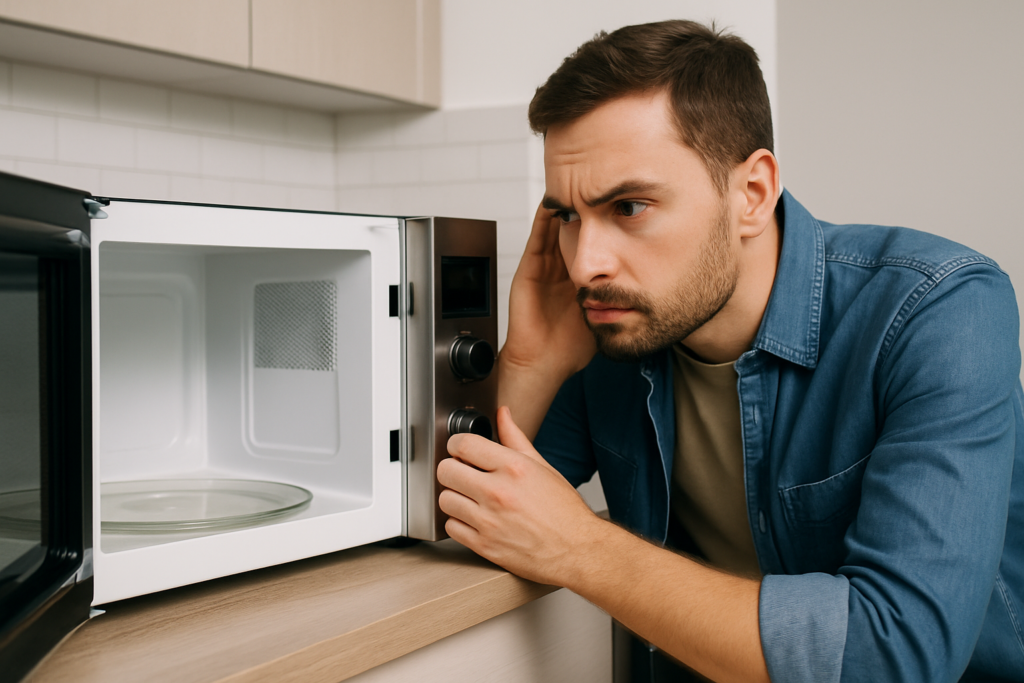
You’re heating up leftovers when suddenly your microwave starts making sounds like it’s auditioning for a horror movie soundtrack. Grinding, buzzing, rattling, or high-pitched squealing can all mean different things, and ignoring these noises usually makes the problem worse. Most of these issues come down to a handful of mechanical components that wear out over time.
The good news is that many microwave noise problems are fixable, and you don’t always need to replace the entire unit. Understanding what each sound means can help you decide whether it’s a quick DIY fix or time to call in a professional.
The Turntable Motor and Roller Guide
If you’re hearing a grinding or scraping noise that syncs up with the turntable rotation, start by looking at the simplest culprit. Food debris, grease, or small objects often get stuck under the turntable or around the roller guide. Remove the glass tray and the plastic roller assembly underneath, then clean everything thoroughly with warm soapy water.
Sometimes the roller guide wheels themselves wear down or crack. These small plastic wheels support the turntable as it spins, and they take a beating over years of use. You can find replacement microwave turntable roller guides for most major brands.
The turntable motor itself can also fail. This motor sits below the microwave floor and connects to the turntable coupler. When it starts to go bad, you’ll hear a humming or buzzing that wasn’t there before. Replacing a turntable motor requires accessing the bottom of the microwave, but it’s one of the easier repairs if you’re comfortable with basic appliance work.

Microwave Turntable Motor Kit
Compatible with most major brands and includes installation hardware
Magnetron Issues and High-Pitched Noises
A high-pitched whining or screeching sound often points to the magnetron, which is the component that actually generates the microwaves. This is the heart of your microwave, and when it starts making noise, it’s usually because the internal components are degrading.
Magnetron problems typically develop gradually. You might notice the sound getting louder over several weeks or months. Sometimes the noise is accompanied by sparking inside the microwave cavity or uneven heating. While magnetrons can technically be replaced, they’re expensive components that require working around high-voltage capacitors.
For most people, if the magnetron is failing, it makes more sense to replace the entire microwave unless you have a high-end model or a built-in unit. Magnetrons hold their charge even when unplugged, which makes DIY replacement genuinely dangerous without proper training.
Cooling Fan Problems
Your microwave has at least one cooling fan, and some models have two or three. These fans keep the magnetron and other electronic components from overheating. When a fan bearing starts to wear out, you’ll hear rattling, buzzing, or a sound like something is rubbing against plastic.
Fan noise often increases as the microwave heats up during operation. You might not hear it at all during the first 30 seconds, but then it kicks in and gets progressively louder. Dust buildup on fan blades can also cause noise and reduce cooling efficiency.
Check your microwave’s exterior vents for dust and debris. Most models have vents on the sides, back, or top. Cleaning these vents with compressed air can sometimes quiet a noisy fan. If the fan motor itself is failing, you’ll need to access the internal components to replace it.
Replacement microwave cooling fans are available for most brands, but installation requires removing the outer case and working near electrical components. Always unplug the microwave and discharge the high-voltage capacitor before attempting any internal repairs.
Stirrer Motor and Cover Issues
Many microwaves use a stirrer fan instead of or in addition to a turntable. This is a small metal fan mounted in the ceiling of the microwave cavity that helps distribute microwave energy evenly. When the stirrer motor or the metal cover over it becomes loose or damaged, you’ll hear rattling or grinding from above.
Check the stirrer cover inside your microwave ceiling. It’s usually a plastic or metal plate held in place by screws or clips. Make sure it’s secure and hasn’t warped from heat. If the cover is damaged, you can order a replacement for your specific model.
The stirrer motor itself sits behind this cover. When it fails, you might hear a buzzing sound but see no movement from the stirrer fan blade. This component is less common to fail than fans or turntable motors, but it does happen after years of use.

Microwave Stirrer Motor Assembly
Fixes rattling noises from the ceiling area of your microwave
When to Repair vs. Replace
Not every noisy microwave is worth fixing. As a general rule, if your microwave is over eight years old or if the repair would cost more than half the price of a new unit, replacement makes more sense. Budget countertop microwaves under competitively priced are almost never worth repairing beyond simple cleaning.
Higher-end microwaves, over-the-range models, and built-in units are different. These can cost several hundred dollars to replace, and parts are typically available. Replacing a worn-out fan or turntable motor on a quality microwave can extend its life by several more years.
Consider the repair difficulty too. Simple fixes like cleaning the turntable assembly or replacing the roller guide are easy DIY projects. But anything requiring access to internal components means working near high-voltage parts. Even when unplugged, microwave capacitors can hold enough charge to cause serious injury or death.
If you’re not completely confident about electrical appliance repair, call a professional or replace the unit. The money you save attempting a risky DIY repair isn’t worth a trip to the emergency room.
Frequently Asked Questions
Is it safe to use a microwave that’s making loud noises?
It depends on the noise. Grinding sounds from the turntable area are usually just a cleaning or maintenance issue and safe to use temporarily. But high-pitched squealing, loud buzzing from the magnetron, or any noise accompanied by sparking or burning smells means you should stop using it immediately. These can indicate electrical problems or radiation leakage.
Why does my microwave make noise when not in use?
Some microwaves run their cooling fan for a few minutes after cooking to prevent component damage. This is normal. But if your microwave makes noise while completely idle and not recently used, you might have a control board issue or a stuck relay. Unplug it and have it checked by a technician before using it again.
Can I replace microwave parts myself or do I need a technician?
Simple external parts like turntable components are totally doable for most people. Internal repairs involving the magnetron, capacitor, or diode require specialized knowledge because these components can hold lethal voltage even when unplugged. Unless you have appliance repair experience and proper tools, internal work should be left to professionals.
This article contains affiliate links. We may earn a small commission at no extra cost to you.