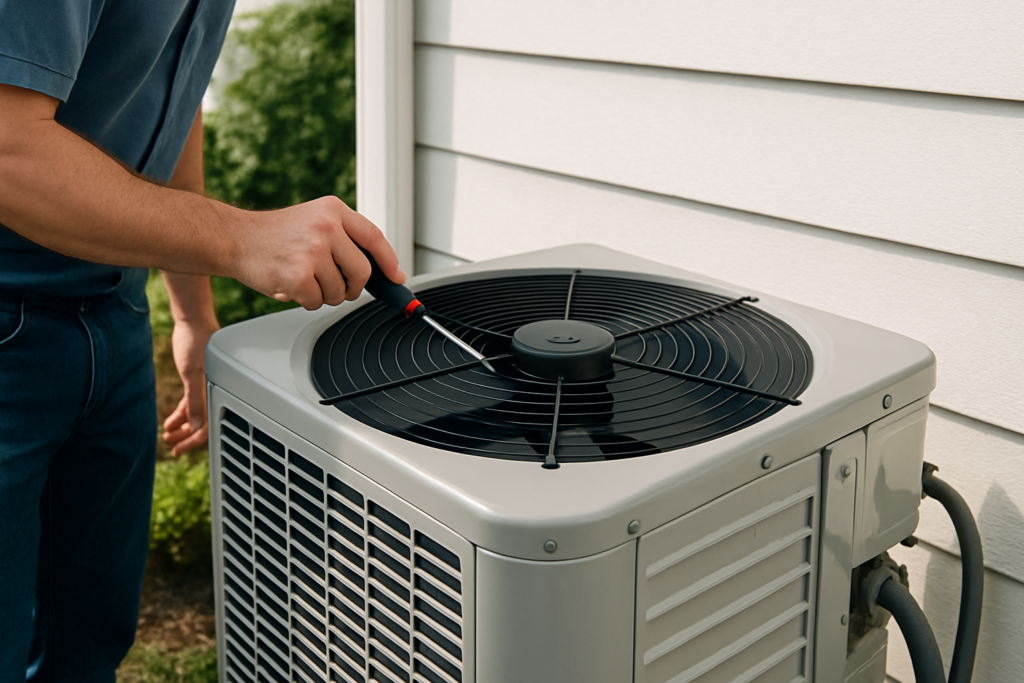
There’s nothing quite like the sinking feeling you get when your air conditioner stops spinning on a sweltering summer day. You flip the switch, hear the compressor kick on, but the fan just sits there, mocking you while your house slowly turns into a sauna.
The good news is that a non-spinning AC fan is usually fixable without calling in a professional. Most causes are relatively simple: a worn belt, a failed capacitor, or a faulty motor. Let’s walk through what’s happening and how you can get your unit back up and running.
Understanding What Makes Your AC Fan Spin
Your air conditioner’s fan is controlled by a motor that relies on several components working together. When one fails, the whole system stops. The most common culprits are the capacitor (which gives the motor the electrical jolt it needs to start), the fan motor itself, or in older belt-driven units, a worn or broken belt.
Before you do anything else, turn off the power to your AC unit at the breaker box. You’ll be working with electrical components and moving parts, so safety comes first.
Check the Capacitor First
The capacitor is often the first thing to fail, especially in units that are more than five years old. This cylindrical component stores electricity and releases it in a burst to start the fan motor. When it goes bad, the motor hums but won’t spin.
You can spot a failed capacitor by looking for a bulging top, leaking oil, or a burnt smell. Remove the access panel on your outdoor unit and locate the capacitor. It’ll have wires connected to the top and will be labeled with voltage and microfarad ratings.

Air Conditioner Capacitor
Replacement capacitors are essential for getting your fan motor spinning again when the original fails
Replacing a capacitor is doable for most homeowners, but you need to discharge it first. Use an insulated screwdriver to touch the terminals together (while wearing rubber gloves). Then disconnect the wires, noting which wire goes where, and install the new capacitor matching the exact specifications on the old one.
Inspect the Fan Belt (For Belt-Driven Systems)
Older AC units and some commercial systems use belts to connect the motor to the fan. These belts wear out over time, developing cracks, glazing, or simply breaking. A broken belt is immediately obvious, but a worn belt might slip and fail to turn the fan even though the motor is running.
Remove the fan housing to access the belt. Check for cracks, fraying, or a shiny, glazed appearance. Press down on the belt at its midpoint. It should have about half an inch of give. Too loose and it’ll slip; too tight and it’ll wear out the bearings in your motor.
When replacing a belt, make sure you get the correct size. The belt will have a number stamped on it (something like 4L390 or B42). This indicates the belt type and length. Installing the wrong size will cause premature failure or damage to your motor.
You can find HVAC fan belts for most standard units, but having your model number handy helps ensure you get the right match.
When the Motor Is the Problem
Sometimes the fan motor itself burns out. You’ll know this is the issue if you’ve replaced the capacitor, checked the belt (if applicable), and the fan still won’t budge. A failed motor often has a burnt smell, won’t make any noise when power is applied, or might hum briefly before going silent.
Testing a motor requires a multimeter to check for continuity and proper resistance. Most motors will show between 3 and 30 ohms of resistance between the common wire and the run winding. If you get an infinite reading, the motor windings are open and the motor is dead.

Digital Multimeter
Essential for diagnosing electrical issues in your AC system, including capacitor and motor problems
Replacing a fan motor is more involved than swapping a capacitor. You’ll need to remove the fan blade, disconnect all wiring, unbolt the motor from its mounting bracket, and reverse the process with the new motor. Make sure the replacement motor matches your unit’s specifications: horsepower, voltage, speed (usually 1075 RPM for condensers), and rotation direction.
The Lid Switch Problem (For Window Units)
Window air conditioners have a safety feature that many people don’t know about: a lid switch. This small switch prevents the unit from running when the cover is removed. It’s a safety mechanism to keep you from sticking your fingers into a spinning fan.
Over time, these switches can fail or become stuck. The switch is usually located near where the cover attaches to the unit. It’s a small plastic button that gets pressed when the cover is in place.
Try pressing this switch manually while the unit is on (carefully, and only after checking that the fan isn’t about to start spinning). If the fan starts, you’ve found your problem. You can temporarily bypass the switch by taping it down, but the proper fix is replacing it. These switches are inexpensive and usually held in place by a single screw or clip.
Other Things to Check
Sometimes the issue is simpler than a failed component. Debris can jam the fan blade, preventing it from spinning. Turn off the power and try rotating the fan blade by hand. It should move freely with just a bit of resistance. If it’s stuck or grinding, remove any leaves, twigs, or other debris that might have gotten inside.
Also check the fan blade itself. A bent or damaged blade can throw off the balance and prevent the motor from starting. Small bends can sometimes be carefully straightened, but badly damaged blades need replacement. You can find condenser fan blades in various sizes to match your unit.
Finally, verify that your unit is getting power. A tripped breaker or blown fuse will prevent everything from working. Check your electrical panel and reset any tripped breakers. If the breaker trips again immediately, you have a short circuit somewhere and should call a professional.
Frequently Asked Questions
Can I run my air conditioner if the fan isn’t spinning?
No, you shouldn’t run your AC with a non-spinning fan. The fan removes heat from the condenser coils. Without it, the compressor will overheat and potentially fail, which is a much more expensive repair than fixing the fan. Turn off the unit immediately and address the fan problem first.
How long do AC fan motors typically last?
A quality fan motor should last 10 to 15 years with proper maintenance. Motors fail prematurely when they overheat due to restricted airflow, run continuously without breaks, or are exposed to excessive moisture. Regular cleaning and allowing your system to cycle normally extends motor life considerably.
Is it worth repairing an old AC unit or should I replace it?
If your unit is less than 10 years old and the repair costs less than half the price of a new unit, repair it. For units older than 15 years, especially those using R-22 refrigerant, replacement often makes more financial sense. Newer units are significantly more efficient and will save you money on electricity bills over time.
This article contains affiliate links. We may earn a small commission at no extra cost to you.