You pull your clothes out of the dryer expecting them to be warm and fresh, but instead they’re damp or completely cold. Before you panic and call a repair technician, you should know that most dryer cooling issues stem from a handful of fixable problems. Understanding what’s causing your dryer to blow cold air can save you hundreds in repair costs.
Let’s walk through the most common culprits and how to tackle them yourself.
Airflow Restrictions Are Usually the First Suspect
Your dryer needs proper airflow to heat effectively. When lint builds up in the exhaust vent or lint trap, it chokes off the circulation your dryer depends on. Even a partially blocked vent can reduce heating efficiency by 50% or more.
Start by cleaning your lint trap thoroughly. You’d be surprised how much residue builds up even if you clean it after every load. Remove the screen and wash it with warm soapy water to eliminate any waxy buildup from dryer sheets.
Next, check the exterior vent where your dryer exhausts outside. Disconnect the vent hose from the back of your dryer and look inside. You’re looking for visible lint clogs or any crushed sections of ductwork that might restrict airflow.
A dryer vent cleaning kit with flexible rods can help you clear out the entire vent line from inside your home. This is especially important if your vent run is longer than 10 feet or includes multiple bends.

Dryer Vent Cleaning Kit
A flexible rod system that connects to your drill makes cleaning long vent runs much easier
Heating Element or Coil Failures
If your airflow is fine but the dryer still won’t heat, the heating element itself might be damaged. Electric dryers use a coiled heating element that glows red hot to warm the air. These elements can break or burn out over time, especially in high-use households.
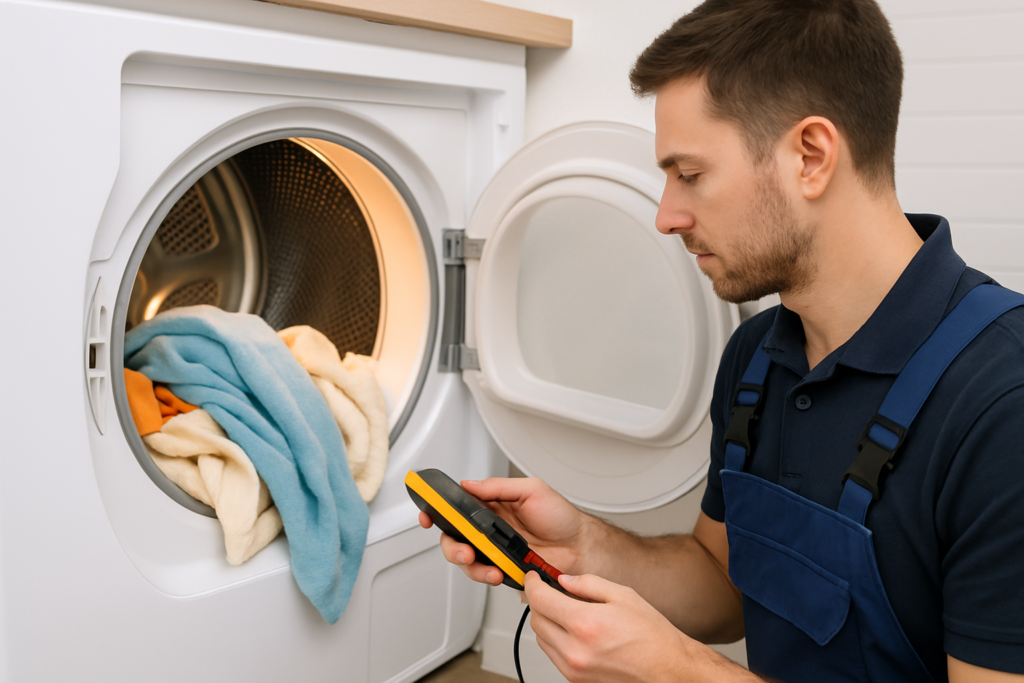
You can test the heating element with a multimeter set to measure resistance. Disconnect power to your dryer first (this is critical for safety). Remove the back panel and locate the heating element housing. It usually looks like a metal box with wires connected to it.
A functioning heating element should show continuity on your multimeter. If it reads infinite resistance or shows visible breaks in the coil, you’ll need to replace it. The good news is that replacement heating elements are model-specific but widely available online.
Make sure you have your dryer’s exact model number before ordering. You’ll find this on a metal plate inside the door frame or on the back panel of the unit.

Multimeter for Appliance Testing
Essential for diagnosing electrical issues in dryers and other home appliances
Thermal Fuses and High-Limit Thermostats
Your dryer has several safety devices designed to prevent overheating. The thermal fuse is a one-time safety device that blows permanently if your dryer gets too hot. Once it blows, your dryer will tumble but won’t produce any heat.
The thermal fuse is usually located on the blower housing or heating element housing. You can test it with a multimeter just like the heating element. If it shows no continuity, it’s blown and needs replacement.
High-limit thermostats work similarly but are resettable. These can trip if your dryer overheats due to restricted airflow. Sometimes simply fixing the airflow issue and letting the thermostat cool down will restore heating function.
Keep in mind that if a thermal fuse has blown, there’s usually an underlying cause. Don’t just replace the fuse without addressing the airflow restriction or other issue that caused it to blow in the first place.
When It’s Actually a Gas Valve or Igniter Problem
Gas dryers have different components that can fail. The igniter glows white-hot to ignite the gas, while gas valve solenoids control the flow of gas to the burner. You can often hear the igniter clicking if you listen carefully while the dryer runs.
If your gas dryer isn’t heating, watch through the lower front panel (with the dryer running) to see if the igniter glows. If it glows but doesn’t ignite the gas, you likely have bad gas valve coils. If it doesn’t glow at all, the igniter itself needs replacement.
Gas dryer repairs require more caution due to the fuel source involved. If you’re not comfortable working with gas appliances, this is when calling a professional makes sense.
Frequently Asked Questions
How long should a dryer heating element last?
A typical dryer heating element lasts 8 to 18 years depending on usage and maintenance. If you run your dryer daily or have restricted airflow causing it to work harder, you’ll see shorter lifespan. Regular vent cleaning can extend the life of your heating element significantly.
Can a dryer run without heat and still damage clothes?
Yes, running a dryer without heat for extended periods can actually damage certain fabrics through excessive mechanical tumbling. More importantly, it wastes energy and time. If your dryer isn’t heating properly, address the issue rather than just running longer cycles to compensate.
This article contains affiliate links. We may earn a small commission at no extra cost to you.