
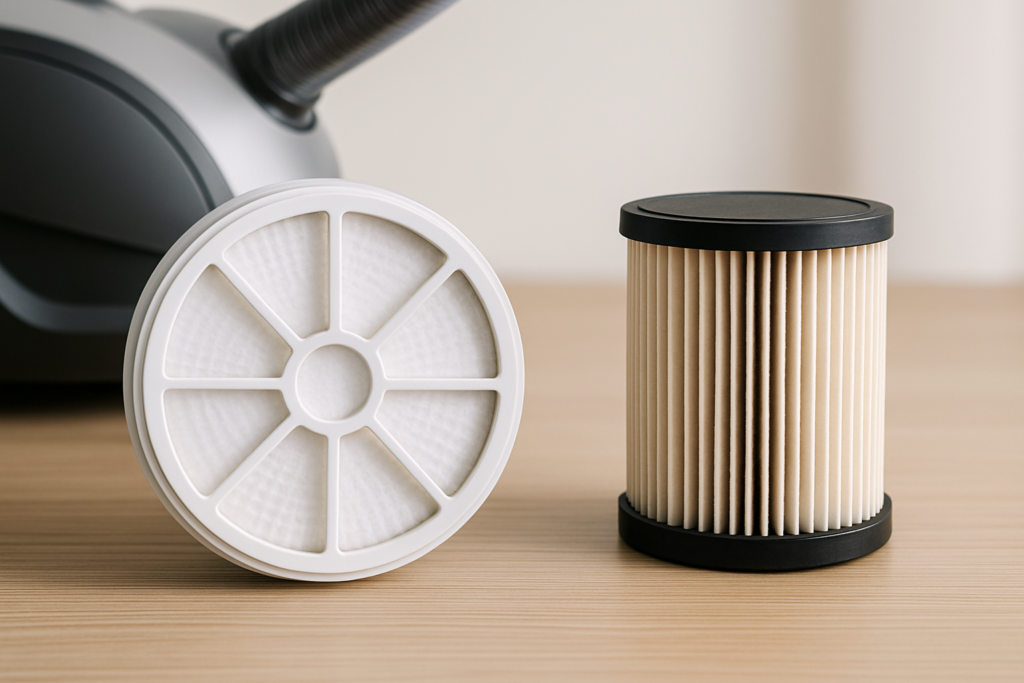
Your vacuum cleaner works hard to keep your floors clean, but the real magic happens inside the machine where microscopic particles get trapped by the filter. While shopping for replacement filters or a new vacuum, you’ve probably noticed the price difference between standard filters and HEPA filters. That difference can be significant, sometimes triple the cost.
The question becomes whether that extra money actually delivers better results for your specific situation. Your household’s needs depend on factors like allergies, pets, air quality concerns, and budget constraints. Some families absolutely need HEPA filtration, while others get perfectly good results from standard filters at a fraction of the cost.
Let’s break down exactly what each type offers, who benefits most from which option, and how to make the right choice for your home without overspending on features you don’t need.
Understanding HEPA Technology
HEPA stands for High Efficiency Particulate Air, and it represents a specific standard rather than just a marketing term. True HEPA filters must capture 99.97% of particles that are 0.3 microns or larger. This standard was originally developed for nuclear facilities and cleanrooms where air purity was critical.
The technology works through three different mechanisms. Large particles get trapped through impaction when they crash directly into fibers. Medium-sized particles get caught through interception as they follow air currents too close to fibers. The smallest particles move erratically due to Brownian motion and eventually diffuse into the filter material.
Most vacuum manufacturers now offer “HEPA-type” or “HEPA-style” filters alongside true HEPA options. These alternatives typically capture 85-95% of particles at 0.3 microns, which sounds close but represents a significant difference in performance. A 5% gap means roughly 20 times more particles escape compared to true HEPA filtration.
How Standard Filters Work
Standard vacuum filters come in several varieties, from basic foam and cloth filters to more advanced pleated designs. Most capture particles down to about 10-20 microns effectively, which handles visible dust, dirt, and larger debris without problems.
Pleated standard filters offer the best performance in this category. They use more surface area and denser material than basic filters, typically capturing particles down to 5-10 microns. For comparison, human hair measures about 50-100 microns, so standard filters handle most of what you can actually see.
The main advantage of standard filters lies in their simplicity and cost-effectiveness. They don’t restrict airflow as much as HEPA filters, which means your vacuum maintains stronger suction power. They’re also washable in many cases, reducing long-term replacement costs.
Filtration Efficiency Compared
The performance gap between HEPA and standard filters becomes most apparent when dealing with microscopic particles. Dust mites, pollen, pet dander, and bacteria typically measure between 0.3-10 microns. Standard filters catch some of these particles, but many escape back into your air.
HEPA filters excel at trapping these microscopic allergens. They capture 99.97% of pollen (typically 10-100 microns), virtually all pet dander (0.5-3 microns), and most bacteria (0.3-5 microns). Standard filters might catch 60-80% of these same particles, depending on their quality.
However, both filter types perform similarly on larger debris like dirt, crumbs, and visible dust. Your vacuum’s suction power and brush design matter more for this type of cleaning than filter efficiency. Standard filters won’t hold back your vacuum’s performance for everyday cleaning tasks.
Cost Analysis and Value
HEPA filters typically competitively priced-40 each, while comparable standard filters run competitively priced-15. Over a year, assuming quarterly replacements, you’ll spend competitively priced-160 on HEPA filters versus competitively priced-60 on standard options. This difference adds up significantly over your vacuum’s lifespan.
Some HEPA filters are washable, which changes the cost equation. Washable HEPA filters cost more upfront (competitively priced-60) but last 6-12 months with proper cleaning. You’ll still need to replace them eventually as the filtration efficiency degrades over time.
Consider the hidden costs too. HEPA filters create more airflow restriction, making your vacuum motor work harder. This can lead to slightly higher energy bills and potentially shorter motor life. Standard filters maintain better airflow, reducing strain on your vacuum’s components.
The value proposition depends entirely on your specific needs. If you’re dealing with allergies or asthma, the extra cost delivers measurable health benefits. For general cleaning in homes without air quality concerns, standard filters provide excellent value.
Best Choice for Allergy Sufferers
Allergy sufferers should invest in true HEPA filtration without question. The difference in symptom relief justifies the higher cost for most people dealing with seasonal allergies, dust sensitivity, or asthma triggers.
Pollen particles range from 10-100 microns, which standard filters can partially capture. However, broken pollen fragments and the most problematic allergens often measure under 5 microns. HEPA filters trap these smaller particles that cause the most severe reactions.
Look for vacuums with sealed systems when choosing HEPA filtration for allergies. Even the best HEPA filter won’t help if allergens escape through gaps in the vacuum housing. Brands like Miele, Shark Navigator, and several Dyson models offer properly sealed HEPA systems.
Replace HEPA filters every 6-12 months for optimal allergy control. A saturated filter loses efficiency and can actually release trapped allergens back into your air. Mark your calendar and don’t try to extend filter life beyond manufacturer recommendations.
Pet Owner Considerations
Pet owners face a unique challenge because pet dander particles are incredibly small, typically 0.5-3 microns. Standard filters miss most dander particles, allowing them to recirculate through your home’s air system and settle on surfaces you just cleaned.
Pet hair itself isn’t the main concern since both filter types handle visible hair equally well. The invisible dander that triggers allergies and creates that persistent pet smell requires HEPA-level filtration to control effectively.
Multiple pet households benefit most from HEPA filters. The volume of dander and microscopic particles increases significantly with each additional animal. Standard filters become overwhelmed and less effective in these situations.
Consider washable HEPA filters if you have pets. Pet dander and hair can clog filters faster than normal household dust. Being able to rinse and reuse your filter reduces maintenance costs and ensures consistent performance between replacements.
Maintenance Requirements
Standard filters win on maintenance simplicity. Most are washable with water and mild soap. You can clean them monthly and expect 6-12 months of service life depending on usage. Some basic foam filters last even longer with regular cleaning.
HEPA filters require more careful handling. True HEPA filters cannot be washed without destroying their filtration capability. You can use compressed air or gentle vacuum cleaning to remove surface dust, but this only extends life slightly.
Washable HEPA filters need specific cleaning procedures. Use cool water and very gentle pressure. Hot water or aggressive scrubbing damages the filter media. Allow 24-48 hours for complete drying before reinstalling to prevent mold growth.
Monitor both filter types for damage during cleaning. Tears, holes, or compressed areas significantly reduce filtration efficiency. Replace damaged filters immediately rather than trying to repair them.
Replacement Costs Over Time
Standard filters deliver the lowest total cost of ownership for most households. Even premium pleated standard filters cost less than basic HEPA options. Over five years, you’ll spend roughly competitively priced-300 on standard filter replacements.
HEPA filter costs vary dramatically based on your vacuum brand and model. Popular models like the Shark Navigator HEPA replacements cost competitively priced-25 each. Premium brands like Miele can run competitively priced-50 per filter.
Generic HEPA filters often cost 30-50% less than brand-name options. However, filtration efficiency isn’t guaranteed to meet true HEPA standards. Stick with reputable manufacturers or verified aftermarket options that specify 99.97% efficiency at 0.3 microns.
Factor in your vacuum usage when calculating costs. Heavy-use households need more frequent replacements regardless of filter type. Light users might extend replacement intervals slightly, but don’t compromise air quality to save money on filters.
Performance in Different Home Environments
Urban homes with higher air pollution benefit significantly from HEPA filtration. Traffic exhaust, industrial particles, and urban dust contain more harmful microscopic particles that standard filters miss. The outdoor air quality directly impacts what your vacuum needs to capture.
Rural and suburban homes often get good results from high-quality standard filters. Lower baseline air pollution means less microscopic contamination indoors. Focus your budget on more frequent filter changes rather than upgrading to HEPA unless you have specific health concerns.
Homes with forced-air heating and cooling systems create different filtration demands. HVAC systems already filter some airborne particles, reducing the burden on your vacuum filter. However, if your central air system uses basic filters, your vacuum becomes more important for air quality.
Basement workshops, garages, and hobby areas generate fine dust that requires HEPA filtration. Woodworking dust, metal particles, and craft materials create health hazards that standard filters can’t address adequately.
Making Your Decision
Choose HEPA filters if you have diagnosed allergies, asthma, or respiratory sensitivities. The health benefits outweigh the extra costs for people with medical reasons to control airborne particles. Don’t compromise on air quality when dealing with health issues.
Pet owners with multiple animals should invest in HEPA filtration. The volume of dander and microscopic particles overwhelms standard filters in multi-pet households. Single pet homes can often manage with high-quality standard filters unless family members have pet allergies.
Standard filters work well for general cleaning in healthy households. Focus on buying quality pleated filters and replacing them regularly rather than upgrading to HEPA. Spend the saved money on more frequent professional carpet cleaning or other home maintenance.
Consider your vacuum’s design when making this choice. Some models perform poorly with HEPA filters due to airflow restrictions. Check manufacturer recommendations and user reviews before switching filter types on older vacuums.
Product Recommendations
For reliable HEPA replacement filters, the Bissell CrossWave HEPA filters offer excellent value for multi-surface cleaning. They maintain strong suction while delivering true HEPA performance.
Dyson users should stick with genuine Dyson HEPA replacement filters for optimal performance. Generic alternatives often don’t fit properly or meet filtration standards despite lower prices.
Budget-conscious shoppers can find quality generic HEPA filters that meet true HEPA standards. Look for products that specifically mention 99.97% efficiency at 0.3 microns rather than vague “HEPA-style” claims.
Standard filter users should consider washable pleated filters for the best long-term value. These offer better performance than basic foam filters while maintaining low operating costs.
Frequently Asked Questions
How often should I replace HEPA filters versus standard filters?
HEPA filters typically need replacement every 6-12 months depending on usage and air quality. Standard filters can often go 3-6 months between changes. However, visible dirt buildup and reduced suction are better indicators than time alone. Replace any filter that appears heavily soiled or causes noticeable performance drops.
Can I wash true HEPA filters to extend their life?
True HEPA filters should never be washed with water, as this destroys the filtration media and eliminates their effectiveness. You can gently clean surface dust with compressed air or light vacuuming, but this only provides minimal life extension. Only filters specifically labeled as “washable HEPA” can be cleaned with water.
Do HEPA filters reduce my vacuum’s suction power?
HEPA filters do create more airflow resistance than standard filters, which can reduce suction power by 10-20% in some vacuums. However, well-designed vacuum systems account for this and maintain adequate cleaning performance. If you notice significant suction loss after switching to HEPA, your filter may be clogged or your vacuum may not be designed for HEPA filtration.
Are expensive brand-name filters worth the extra cost over generic options?
Brand-name filters guarantee proper fit and filtration standards, but quality generic filters often perform equally well at lower prices. For HEPA filters, verify that generic options meet true HEPA standards (99.97% at 0.3 microns) rather than just “HEPA-type” performance. Standard filters have more flexibility since exact filtration specs matter less for general cleaning.
This article contains affiliate links. We may earn a small commission at no extra cost to you.